Auteur
A screenplay goes in. A film comes out.
Auteur takes a script through scene breakdown, character bibles, storyboards and shot lists, all the way to finished clips — holding your cast, costumes and locations consistent the entire way.
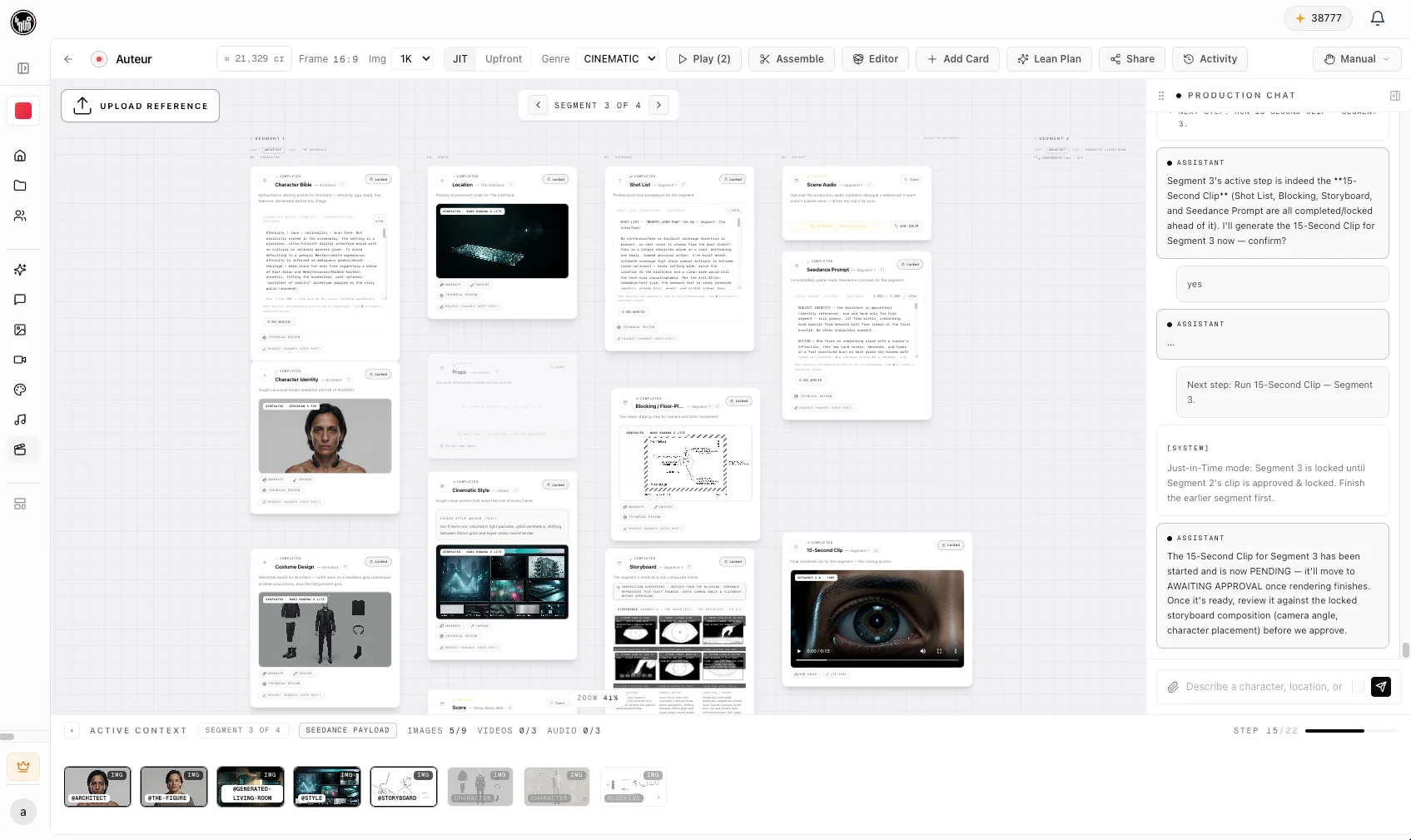
One segment of a film in progress. Every card is a deliverable you approve before the next one unlocks.
Four stages, and you sign off on each one
The order matters — each stage produces the references the next one depends on.
01 · Parse
A screenplay goes in
Upload a script or write one in AI Studio. Auteur breaks it into scenes and segments, and pulls out every character, location and prop it will need to keep straight.
02 · Cast
Characters become references
Each character gets a bible, an identity plate and costume references. Those references are what every later shot points at — which is how a face stays the same face from scene one to the end.
03 · Board
Scenes become storyboards
Shot lists and storyboard frames per segment, composed against your locked style and cast. Rewrite any frame's prompt and re-roll it on its own.
04 · Shoot
Frames become clips
Each approved board becomes a video prompt and then a clip, carrying its references through so continuity survives the jump to motion.
Anyone can make a shot. Auteur makes a film.
Access to 45 models is table stakes. What a production needs is the same character in shot 90 as in shot 1.
- Continuity is the whole point
- Generating one good shot is easy. Generating the ninetieth shot with the same actor, wearing the same coat, in the same room, is the problem Auteur exists to solve. References are locked and carried forward rather than re-described each time.
- You approve every step
- Nothing advances on its own. Each card is drafted, edited if you want, then approved and locked — and locking is what unlocks the work that depends on it. Change something upstream and everything downstream is marked stale rather than silently wrong.
- It runs on the models you already have
- The same catalogue the rest of the platform uses. No separate subscription, no separate credit pool.
Start with one scene
Bring the sequence you most wish people could see, and build that one first. Everything else on the platform — image, video, moodboards, music, the assistant — comes with the same account.